
Date:2026-04-13Author source:BrightsourceView:477
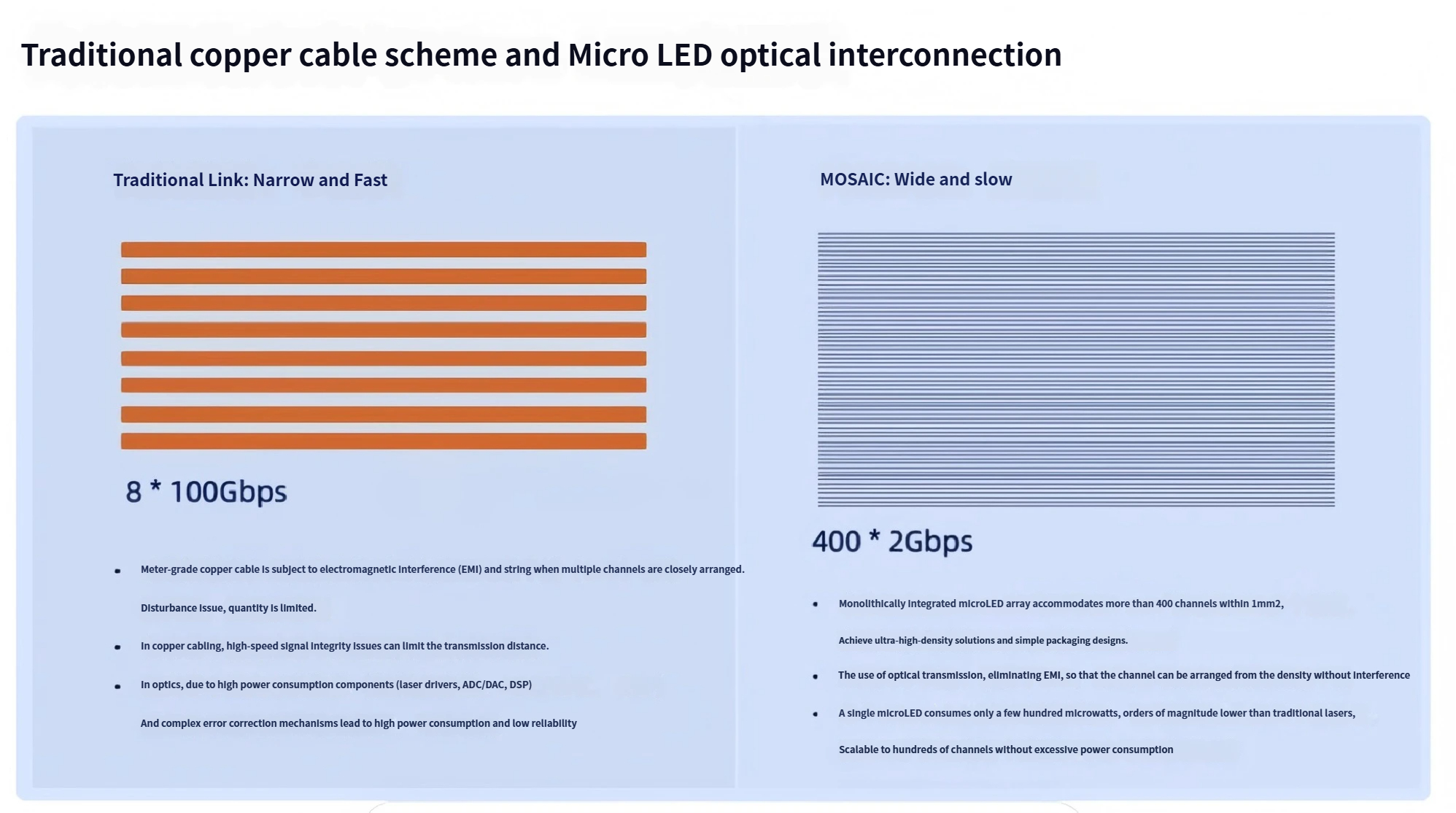
In terms of architecture, based on a paper published by Microsoft Research at SIGCOMM, Microsoft’s MOSAIC adopts the Wide and Slow (WaS) architecture for optical links. It replaces a few high-speed channels with hundreds of parallel low-speed optical channels, subverting the traditional Narrow and Fast (NaF) link mode to achieve long-distance, low-power, and highly reliable transmission.
In short, Micro LED CPO offers three major advantages:
Impact on the LED Industry
In terms of product nature, Micro LED for optical communication and Micro LED for display share the same origin but differ in focus: the former emphasizes high-speed modulation, low power consumption, and wavelength stability, without requiring high brightness. It serves as a high-end customized chip for data center optical transmission.Currently, Micro LED CPO has not truly moved out of the laboratory. Its core bottlenecks lie in technology adaptation, yield improvement, cost control, and industrial chain collaboration. As core participants, LED companies provide irreplaceable support for the industrialization of Micro LED CPO from the lab.
On one hand, LED companies have years of R&D and manufacturing expertise, enabling them to contribute core technologies and focus on optimizing high-speed modulation. They also provide large-scale production capacity, strengthening the cost advantage of Micro LED CPO in mass production.
On the other hand, Micro LED CPO is still in its early stage. It requires huge R&D investment, and low chip yield plus high production line upgrade costs keep the per-module cost high. Even leading enterprises, after technical optimization, cannot match the cost of traditional solutions in the short term. Moreover, data center customers have extremely high requirements for the stability and reliability of optical interconnection solutions, so Micro LED CPO still needs long-term validation.
As an emerging track, Micro LED CPO is expected to drive new growth for the LED industry, but challenges remain: competition in the AI market, incomplete industrial chain support, and cost issues from insufficient commercial viability.Companies need a long-term mindset — collaborative supply chain improvement, differentiated positioning, early customer resource binding, and enhanced commercial feasibility — to drive the steady development of the industry.

COPYRIGHT © BRIGHT SOURCE ALL RIGHTS RESERVED.


